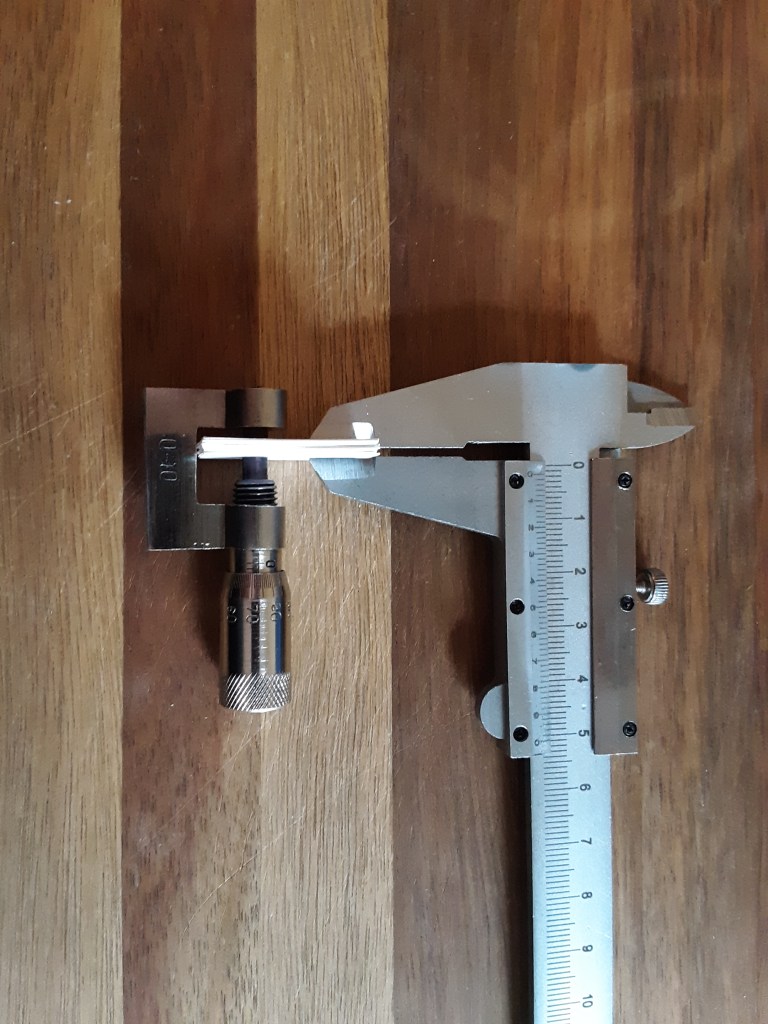
Trying to design a representation of a feather out of paper that creates lift and drag like a real feather does, is easy in Blender as we can represent real life paper using a mesh. The thing to be aware of is that real life paper has a certain thickness. A ream of paper has a thickness of the sum of the individual pages contained therein. If we divide the ream’s thickness by the amount of pages therein, we get the thickness of an individual sheet of paper. In the case of the card stock I am using, the thickness of an individual sheet is 0.00025 meters, or one quarter of a millimeter.
Open in Blender, I draw a flat mesh and give it a solidify modifier. It is easy to work with as you can work with the flat mesh and still have a sheet with a thickness of a quarter of a millimeter everywhere. Even thickness.
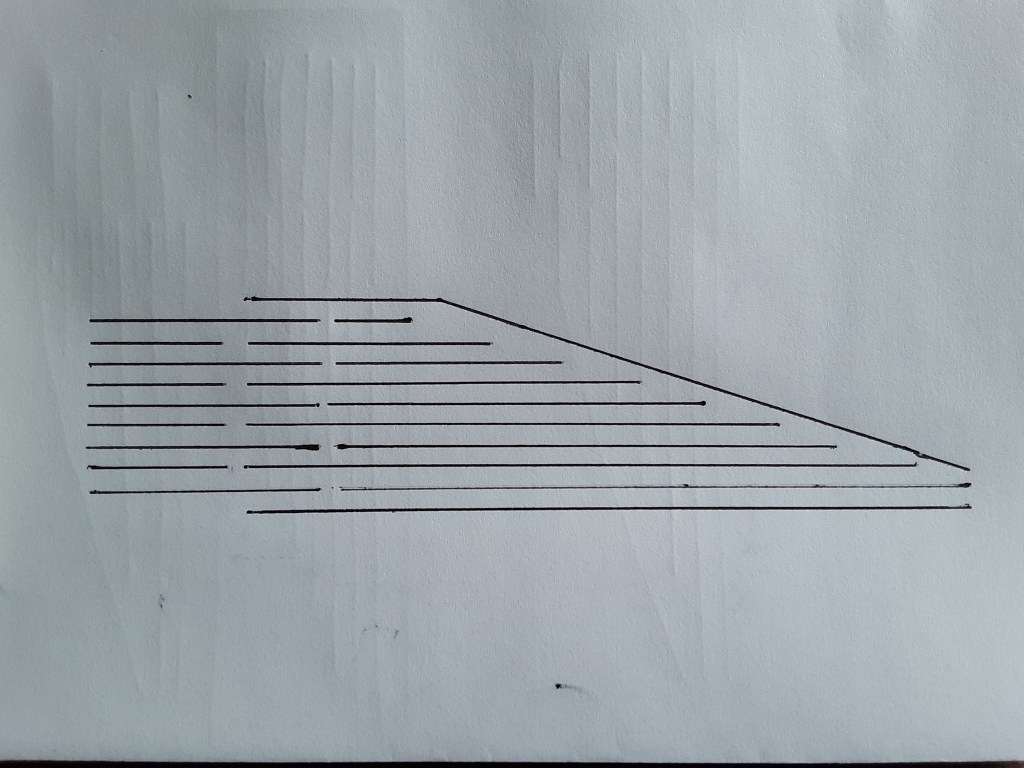
There are a couple of ideas pertaining to designing a strong spar. One is to have most of the material at the top and bottom of the spar, with webbing in the middle. A good spar will not buckle under load. A spar designed for a wing has a great thickness at the root where it attaches to the flying body. In this case the flying body is the wing spar. We have a feather spar connecting to the wing spar. The wing spars represent the flight bones of a bird. The spar I am designing will have a taper from the root to tip. Using several layers of paper we can build the spar beefy at the root, and have the layers terminate before reaching the feather tip, leaving only a few layers there. The profile of the spar resembles a leaf spring, such as one found on a truck’s axle.
I realize I could probably make a whole bunch of feathers out of paper to sell online. Of course, I would want to manufacture them very consistently and to have colors printed on so people will love them.
I want to use angled edges instead of curved edges because that way it will be easier for me to cut out using my craft knife. Each feather is going to look like it can fly on its own. I am at the point where I can probably use my knowledge of Statics in engineering to analyze each feather and decide how thick to make the rachis so that they flex how I want them to.
We have photos of individual feathers but I’m more interested in how feathers are shaped as a group and how they work together as a group. I don’t want to make each feather one at a time. I want to make the feathers as a group.
In practice, drawing the feathers individually can be time-consuming. That’s why I try to edit them as a group. Proportional editing sphere to give the feathers a curve, and scaling them to the correct length.
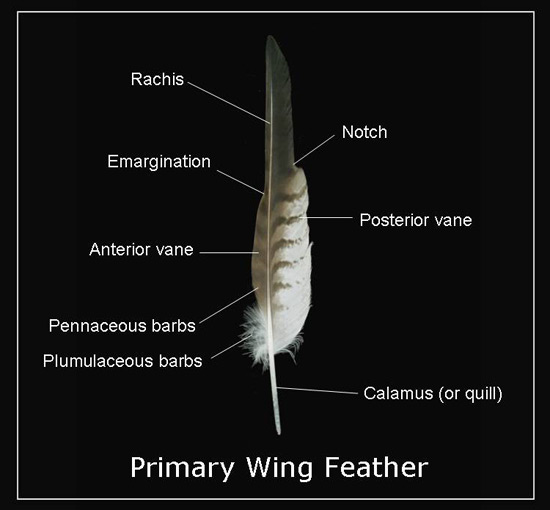
I want the covert feathers to obscure the cables that I will use to tie the primary and secondary feathers together. The area called the afterfeather is a great place to attach cables. I have made some notches which will keep the cables in place. I plan on wrapping the cable around the calamus and gluing it in place.
The feathers have a spar (rachis) of varying thickness. It needs to be stronger at the root where it connects to the rest of the wing. I will use one layer of paper for the vanes and several layers of paper for the rachis. The calamus will be significantly beefy so my feathers won’t fall off.
I learned about shape keys, and with it the ability to morph one shape into another. I can make one feather and add shape keys to it, and duplicate the one feather that has the shape keys for the rest of the feathers in a group. Then adjust the length and curvature of the feather using shape keys to match the reference images.
The length of the calamus plus the rachis does not fit on an 8.5″x11″ printer paper. I have to split up the spar of the longer feathers in lieu of using larger paper. I will use overlapping layers to join the calamus with the rachis.
It looks like bricks. Overlapping layers, with the feather vanes on the top and bottom. The idea is to overlap the layers without making the feather too thick where the overlap takes place. Where the vanes end and the calamus begins, the feather does not need to be any thicker because the distributed load comes from the vane surface area. It just needs to be thick enough so that the bending moment does not break the calamus at the root.
Overall, each feather must be strong yet light. The feathers must attach to adjacent feathers using some sort of cable or rod. They must be able to print on US Letter paper. These criteria will be addressed.
 Singed Pinions